
Over-inflated?
Regarding statues of sports figures

So a Tom Brady statue was unveiled last month outside the New England Patriots football stadium, the old quarterback depicted with a right arm raised in triumph. The thing weighs 12,300 pounds and stands 17 feet tall, but appears a bit out-of-proportion; the head is too small, floating above all that padding.
The obvious intent was to glorify the seven-time Super Bowl champion, so it might have been an opportunity to embody a hackneyed modern sports cliché by sculpting Brady’s little noggin on the body of a goat. Anyway the effigy, which is a poor man’s Michelangelo’s David with clothes, feels excessively worshipful of a fellow whose most significant impact on humanity was throwing a football—accurately, yes, but just a football—and therefore maybe a tad over the top.
Not that such a rite is unusual. There are massive bronze renditions of accomplished jocks in abundance—from baseball’s Babe Ruth to golf’s Tiger Woods, boxing’s Oscar de la Hoya to football’s Johnny Unitas, soccer’s Diego Maradona to hockey’s Wayne Gretzky, as well as sculptures of coaches and sports executives—most having been unveiled while the actual human being was still alive.
But the argument here is that such forms of adoration are better reserved for long-dead figures—therefore not feeding on the objects’ self-importance, as if they are being canonized, somehow representing a purity of virtue impossible for any human being to live up to.
Penn State’s Joe Paterno had been feted for his wildly successful football coaching record with a bronze statue on campus in 2001—only to have it ignominiously removed and hidden away 11 years later. It was judged to have a become a “source of division and an obstacle to healing” after Paterno was found to have covered up allegations of child sexual abuse by his veteran assistant coach. Possibly if the school had waited until Paterno’s complete history was available, and he was safely in his grave, before considering affording him such an honor.
A recent essay by Sally Jenkins in The Atlantic pondered a better use of sports-related sculptures—as representations of something beyond the individual’s specific accomplishments on the playing field. First of all, she noted, “Of all the public indignities great athletes are subjected to, from the meme to the boo to the hurled bottle, undoubtedly the worst is the bad statue. A bronze figure in a stadium plaza is so much more permanent than an insult, and the irony is that a Dwyane Wade or a Michael Jordan has to accept the thing as a compliment. The statue’s intent is to immortalize. Instead, it kills its subject dead.”
It is a common slur, after all, to describe any athlete’s resemblance to a statue, thereby invoking the image of being frozen-in-place while action swirls around him or her.
Jenkins argues that “only one truly great bronze rendering of a renowned athlete [that was] produced in recent decades is the abstract” of tennis champion Arthur Ashe at New York City’s National Tennis Center—which “surges from the earth like a lightning bolt striking upward instead of down. The sculpture, unveiled by the artist Eric Fischl in 2000 and titled Soul in Flight, is worth pausing to look at, for its instructive power and its indictment of the ponderous slabs of metallurgical debris that litter other stadiums and arenas.”
That statue isn’t really a rendering of Ashe, and is not so much lionizing his reign among jocks as a visual of wider possibilities. He was the rare athletic champion who actually connected with the real world—an activist against South African apartheid, a public face in the fight against HIV (which he had contracted through a blood transfusion after a second heart attack), an advocate for children’s education, a published historian.
There is, by the way, a statue in Richmond, Va., that captures a real-life image of Ashe, holding a tennis racket in one hand—but with a message beyond sports. Ashe is surrounded by children, with a stack of books in his other hand. It’s another tableau of wider possibilities.
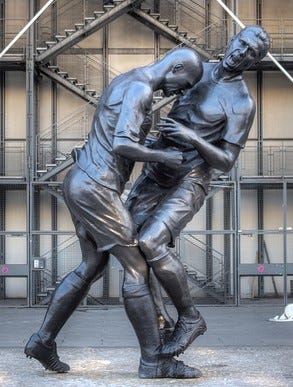
Meanwhile, there happens to be a rare memorial willing to immortalize a star athlete’s infamous moment. In 2012, six years after French soccer hero Zinedine Zidane was ejected from the World Cup final for headbutting an Italian opponent, that confrontation was cast in bronze and placed in Paris. Zidane had been ejected from the game for his misdeed and France lost the match. The statue was christened “Coup de tete”—“Headbutt.”
Its sculptor, Algerian-born French artist Adel Abdessemed, said the aim of his work was to promote conversations about “stress on athletes...and the importance of dealing with issues of mental health.” Real-life stuff.
What if—in the spirit of sports’ (and human) imperfection, of the undeniable temptations to win-at-all-costs—the new Tom Brady statue had showed, in his upraised hand, an air-deficient football, recalling the January 2015 AFC Championship controversy over allegations that Brady had ordered deliberate removal of air from game footballs to aid his passing in New England’s victory over Indianapolis? Brady wound up being suspended for the first four games of the following season and his team was fined $1 million and forced to forfeit two 2016 draft picks. That’s part of his record, too.
They could call the piece “Uninflated.”
John -- Miss the Beetle and Mizzou. Txt that foto. Otherwise: "delivery," not "dellivery," first post.
Was at Citi Field yesterday. Tom Seaver statue in outdoor plaza doesn't much look like the beloved pitcher, caught in what is intended to be mid-dellivery. But it is big and imposing with air of "importance." My view, Seaver is the essential Met, a franchise immortal. Bronze, he doesn't need. Nice column, good idea,