
Good P.R.
Understanding Bad Bunny

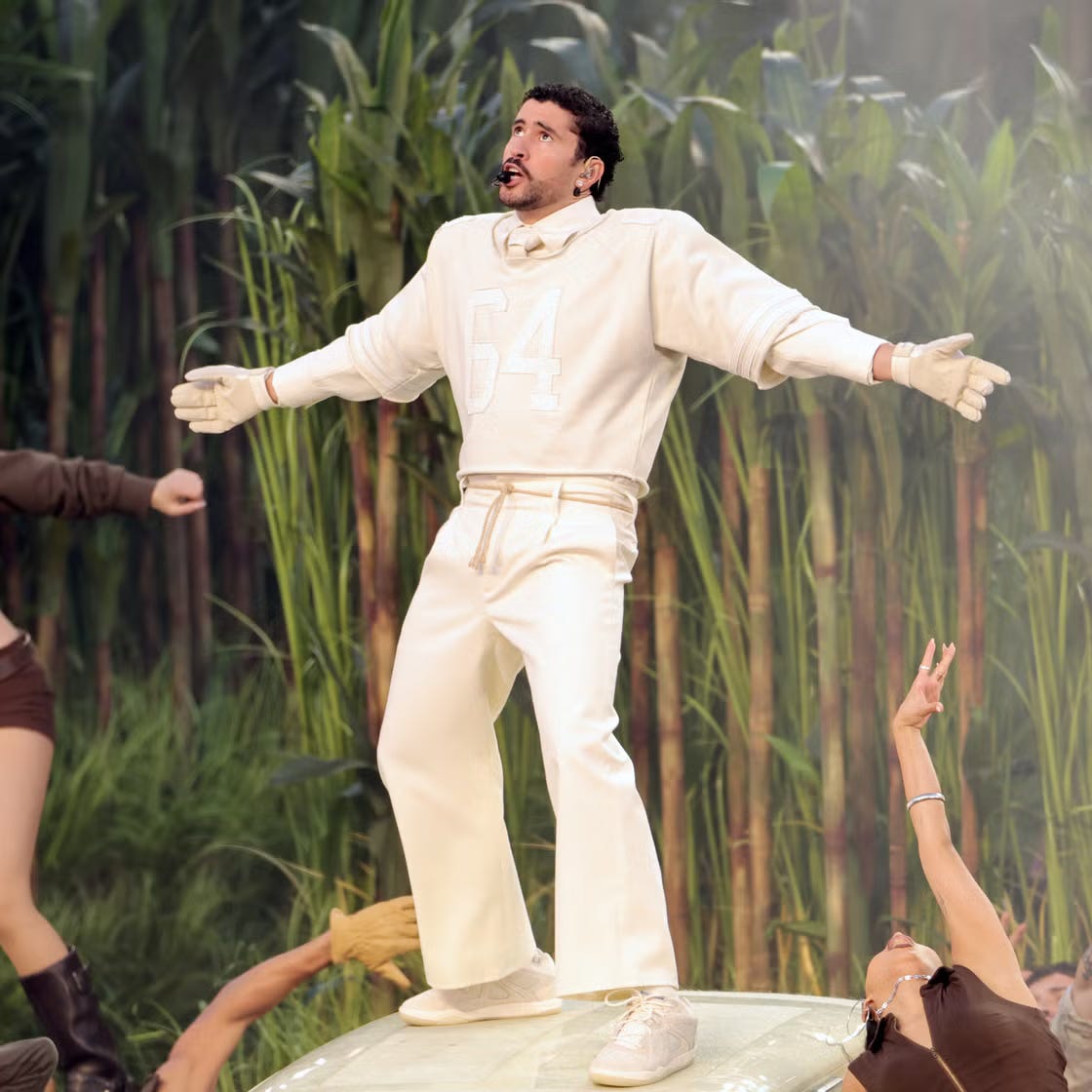
Everything about that Super Bowl halftime affair—the glimpses of Puerto Rican culture, the gaps in apprehension, the hectoring by a certain segment of yahoos—brought back my long-ago embarrassing moment as a dumb bunny. In 1979, I was in San Juan to cover the Pan American Games, the so-called Western Hemisphere Olympics, when a driver pulled alongside my rental car at a stoplight late one summer evening.
From that driver, through his open window: “Que hora es?”
From me: A blank stare, and, “Uhhhhh…”
Again, politely: “Que hora es, por favor?”
Again, baffled, and with elaborate, nonsensical hand motions: “Uhhhhh….I’m sorry. I….I don’t understand….”
“Ah,” he said, and rephrased the question in perfect English: “Do you have the time?”
My lame excuse is that I then was dipping a toe into the international sports waters for the first time, getting an early lesson in traveling beyond these shores, that we Yanks are hardly exceptional in every way. I was discovering my linguistic shortcomings in comparison to the natives, and was exposed, during that event, to a very embodiment of the Ugly American in U.S. basketball coach Bobby Knight.
The pompous, socially clueless Knight (who died in 2023), flaunting his us-against-them conviction, was cited in Sports Illustrated for “gross incivility.” He was ejected from the Americans’ first game of the Pan Am tournament for vehemently arguing calls during a 35-point victory, reprimanded by international basketball officials, arrested and charged in a heated argument with a local policemen, accused of directing demeaning slurs at the women’s team from Brazil and dismissive of then-Puerto Rican Governor Carlos Romero Marcelo when the latter attempted to defuse any thoughts of a home-court conspiracy against the U.S. players. Through it all, Knight took a perverse pride in blustering that he was “not a diplomat,” made it clear he would not speak to Puerto Rican reporters, cursed the locals and belittled them with, “All they know how to do on this damn island is grow bananas.”
Of course he was off-base there, too; Puerto Rico’s economy for decades had been based on a multi-faceted industry and tourism, and before that, sugar cane and coffee. Yes, they had no bananas.
“You do not deserve respect,” Gerraro Marchand, Puerto Rico’s delegate to the international basketball federation, told Knight at the conclusion of the Games. “You treat us like dirt. You have said nothing but bad things since you got here. You are an embarrassment to America. Our country.”
Knight—might he remind you of somebody? –continued, after his departure from San Juan, to repeat his off-color comments in paid speeches. “When that plane was taxiing on the runway and taking off,” Knight told attendees at one rubber-chicken appearance, “I stood up, unzipped my pants, lowered my shorts and turned my bare ass to the window of that plane—because that’s the last thing I wanted those people to see of me.”
As the Games played out, under the swaying Puerto Rican palms and, in some cases, at competition venues overlooking the blue Atlantic, a prominent U.S. journalist from the Washington Post, aghast at incidents of personal discomfort and imperfection, chose to cast aspersions at the locals. His sometimes snarky reports of minor administrative and logistical foul-ups—not always based in fact—moved Governor Romero to publicly denounce the reporter’s “racist tone.”
Some occasional Pan Am traffic issues and miscommunications aside, it’s important to note that, of all the international events I covered over four decades, far greater organizational snafus were experienced from officials at the 1996 Atlanta Olympics, on the home turf of the world’s greatest superpower.
Particularly ironic, amid all the lowly “foreigner” allusions tossed around San Juan in ‘79, was an ignorance among U.S. visitors that Puerto Rico is one of us, a U.S. Commonwealth; that, while they have their own culture and language, Puerto Ricans are U.S. citizens. (Something pointed out by one Benito Antonio Martínez Ocasio during the Super Bowl show).
There are, of course, blockheads extant in every part of this big, round ball upon which we live. But we again have been reminded that some of those are “us,” as well as a few of “them.” Beginning with that Puerto Rican adventure, and through many subsequent trips for coverage of 11 Olympic Games as well as a handful of other global sports happenings, I became convinced that assumptions of superiority, simply based on birth in the U.S. of A., can be woefully misguided. (I also came to appreciate the wisdom of at least attempting a few phrases and greetings in the local tongues.)
By the time I had successfully navigated two other non-U.S.-mainland Pan Am Games—in Havana and Caracas—and through the last of my Olympics at the 2006 Turin Winter Games, it was abundantly clear that neither competence nor grace-under-pressure is the province of a singular land.
Happily, the ’79 Pan Am Games also included chivalrous U.S. folks such as 17-year-old boxer Jackie Beard of Jackson, Tenn., who proclaimed himself “glad I’ve come. Who from my hometown has ever gotten the chance to come to the Pan Am Games and represent his country, and even had a chance to win the gold medal?”—which he did.
Though verbally handicapped—still—I am convinced that an appropriate response to Bobby Knight back then (as well as to the U.S. president who went to San Juan to toss paper towels to hurricane survivors in 2017) would have been….
Hasta nunca. I hope never to see you again.
Or: Y que no ya no regrese. And don’t come back. (Loosely: Good riddance.)
Could be that Puerto Ricans are too polite for that. Meanwhile, to the closed-minded knuckleheads who mocked a Super Bowl show they failed to understand: Respeta al Conejito. Respect the Bunny.
.
The comparison of the late, unlamented Knight with the Felon-in-Chief is right on point.
One of our kids went to IU during the Knight era. He was the same home and away -- the sort of guy who might moon an opponent and think he was giving the fans a treat. Thanks, John.